


Coding agents have made it much easier to start new work, but reviewing, validating, and integrating changes haven’t gotten nearly as easy. In our previous issue, we explored the inventory problem this creates: a growing backlog of agent-generated changes waiting to be shipped. A software factory that only produces more code risks making that backlog bigger instead of getting more software into customers’ hands.
At CircleCI, we’re seeing the strain firsthand in our work with customers and in our own engineering organization. CI activity is increasing rapidly, and engineers are spending more time reviewing and managing agent-generated changes. Adding more agents can increase the cost and coordination required to deliver software without necessarily getting more of it into production.
We’ve been tackling these same challenges by building our own software factory, and we recently shared how it works and the results we’re seeing. Along the way, we’ve learned that improving individual stages of development only gets teams so far. To keep work moving at agent speed, those improvements need to operate as part of a connected system that engineers can oversee and guide.
In this issue, we’ll look at the predictable ways delivery processes break down as agent activity scales, and what it takes to address those problems in a way that lasts.
Where software delivery breaks at machine speed
Most engineering teams already have established processes for getting code into production, but much of that work still depends on shared infrastructure and people coordinating between stages. When agents can generate changes continuously, constraints that were manageable with human-driven development become much harder to work around.
1. Agents confidently implement the wrong thing
When coding agents encounter gaps in a task description, they’ll often fill them in and keep going. A loosely defined task can produce hundreds of lines of working code built around an incorrect assumption about the intended behavior or architecture. The implementation may pass every test while missing the original requirement.
With several agents working in parallel, those assumptions can also pull the codebase in different directions. One agent may introduce a new abstraction while another follows the existing architecture. Changes that appear reasonable individually can create problems when integrated into the same codebase.
Without a shared understanding of the intended design, the team may not discover the problem until review, when correcting it requires substantial rework.
WHAT TO CHANGE
Establish shared intent before agents begin implementation.
One approach is to have agents propose an implementation plan before they start writing code. The amount of planning should reflect the complexity of the work:
For smaller changes, clear acceptance criteria and repository-level instructions may provide enough direction without introducing additional process.
For substantial features or architectural changes, a reviewable design gives engineers a chance to challenge assumptions and agree on the approach before agents invest time implementing it. Developers are used to figuring things out as they code, so the goal isn’t to bring back rigid PRDs. It’s to establish enough direction to avoid costly mistakes while leaving room to adapt as the work progresses.
Teams can also maintain architecture decisions and coding conventions in version-controlled documents that agents reference throughout development. Whatever the approach, agents need consistent direction that carries across sessions, along with a way to ask for guidance when implementation requires an unexpected decision.
We’ve been exploring these ideas through intent-driven development. In Chunk factory, we’ve added a reviewable planning stage so engineers can approve the intended approach before agents begin implementation. Catching expensive misunderstandings early can save far more engineering effort than reviewing the finished code and requesting a rewrite.
2. Testing pipelines become expensive queues
A developer working on one change at a time might trigger a handful of CI runs throughout the day. With several agents working in parallel, that same developer may initiate a steady stream of commits requiring validation. Even when CI infrastructure can handle the additional volume, teams still face higher compute costs and more contention for shared test resources.
Two common sources of overhead become especially costly as agent activity increases:
Redundant test execution. An agent makes a small change, commits it, gets feedback, and commits another fix. If every update triggers a complete test suite, the same unaffected code gets tested repeatedly across every iteration.
Shared resource contention. Setups that worked for one developer at a time become contention points when agents working in parallel compete for the same database or test environment. A flaky test that occasionally interrupted one developer can now disrupt multiple agents at once, triggering additional runs and potentially stopping work until someone investigates.
Our State of Software Delivery research gives a sense of how much validation happens before integration. At the median, organizations run roughly four CI workflows on feature branches for every one on main. That’s about five CI cycles for every change that reaches main, with each one consuming more compute, more tokens, and more developer time along the way.
Not all of that activity is wasted. But when agents are generating changes around the clock, unnecessary validation cycles add up quickly.
WHAT TO CHANGE
Run fewer unnecessary tests and give agents feedback they can act on.
One approach is to separate the fast checks agents need during implementation from the broader validation required before integration. Agents can run targeted tests as they work, while test impact analysis helps avoid repeatedly executing tests unaffected by a change. CircleCI’s Smarter Testing applies this approach in CI, using test impact analysis to select relevant tests and automatically retrying failed tests to help distinguish flaky failures from genuine problems.
Isolation addresses another source of delays. Separate worktrees and containerized dependencies let agents develop and test in parallel without interfering with one another. For teams that want validation to happen outside an agent’s development environment, isolated execution environments such as Chunk sidecars can run repository-defined checks before a change reaches CI.
Agents also need access to test results they can act on. When an agent can investigate a failure and attempt a fix without waiting for someone to interpret the logs, validation becomes part of its development process rather than another manual handoff. Broader checks can still run at integration points where they provide additional confidence.
3. Review and merging become the new bottleneck
The review queue can grow quickly when agents produce pull requests faster than engineers can evaluate them. Senior engineers end up spending more of their time reviewing routine changes instead of working on problems that require their expertise, without necessarily increasing the amount of code the team actually merges. Hiring additional reviewers to keep pace undermines much of the productivity benefit, while asking existing reviewers to move faster increases the risk of mistakes.
Parallel development makes the review problem harder. Two agents can independently produce valid changes that conflict with each other. By the time the second PR reaches the front of the queue, the first may have changed the files it depends on. The longer a PR waits, the larger the conflict tends to be. Resolving the conflict means rebasing and rerunning tests, potentially followed by another review.
WHAT TO CHANGE
Automate routine review and merge preparation without removing human judgment.
Many teams already rely on automated checks to enforce coding standards. AI-based reviewers can extend that approach by examining implementation choices against project conventions or identifying defects that conventional static analysis might miss. Giving these reviewers specific criteria produces more useful feedback than simply asking whether a change looks correct.
Review automation becomes more valuable when agents can act on the feedback. Instead of leaving comments for an engineer to investigate later, teams can route findings back to coding agents for correction and revalidation. Merge queues can help coordinate changes arriving in parallel, while routine rebasing can also be automated.
Automated review was one of the first capabilities we developed for Chunk factory. Our review agent has evaluated more than 5,000 pull requests and approved nearly 3,900 of them. Engineers still make the final merge decisions, but the routine work required to get a change ready no longer has to depend entirely on their availability.
4. Deployment and verification can’t keep up with completed work
A change can pass automated tests and code review and still need to be verified in a running application, especially when it affects integrations or user-facing behavior. For teams that rely on manual verification or shared staging environments, getting access to the right environment can take longer than the implementation itself.
When agent-generated changes arrive continuously, shared environments become contested resources. Teams may end up waiting for a deployment slot or for someone to perform verification, then batching more changes into each release to reduce the overhead.
Larger batches make failures harder to isolate and rollbacks more consequential, so some of the speed gained during implementation is lost before the software ever reaches production.
WHAT TO CHANGE
Make verification environments available on demand and automate the checks that don’t require human judgement.
Ephemeral preview environments offer one way to reduce contention. Each change gets an isolated environment where engineers or automated tests can verify its behavior without waiting for access to shared staging infrastructure. Teams can provision these environments through existing deployment platforms or use infrastructure-as-code to create and remove them as needed.
Automated smoke tests can provide an initial level of confidence before human verification. For production releases, progressive delivery approaches such as canary deployments or feature flags allow teams to release smaller changes while limiting the impact of failures. CircleCI’s Smart Deployments adds continuous release validation, with the ability to trigger automated rollbacks when configured health checks indicate a problem.
The right combination depends on the application and its risk profile. Some changes still warrant careful manual verification, but routine checks and environment setup shouldn’t require the same amount of human coordination every time an agent finishes its work. Even with automated checks and on-demand environments, teams still need a reliable way to move changes through verification and make the results available for the next decision.
Individual solutions help. Building a factory changes what’s possible.
Improving individual parts of the delivery process can make a real difference, but teams can still lose much of that benefit in the handoffs between tools. An agent might be perfectly capable of fixing a failed test, yet the work sits idle because the results never make it back into the agent’s workflow. As the volume of agent-generated changes grows, coordinating work between steps can become just as much of a challenge as improving the steps themselves.
A software factory addresses the coordination problem by connecting agents and development tools into a system that can manage work across the entire process. Instead of relying on independent agent sessions and manual handoffs, it maintains the state of each change so feedback can reach the right agent and work can continue. Engineers retain control over approvals and important decisions, with a consistent view of the work happening across the system. Rather than hopping between sessions to check on each step, they can keep more parallel work moving and focus on the decisions where their judgment matters most.
Here’s how that changes the way everyday development work gets done:
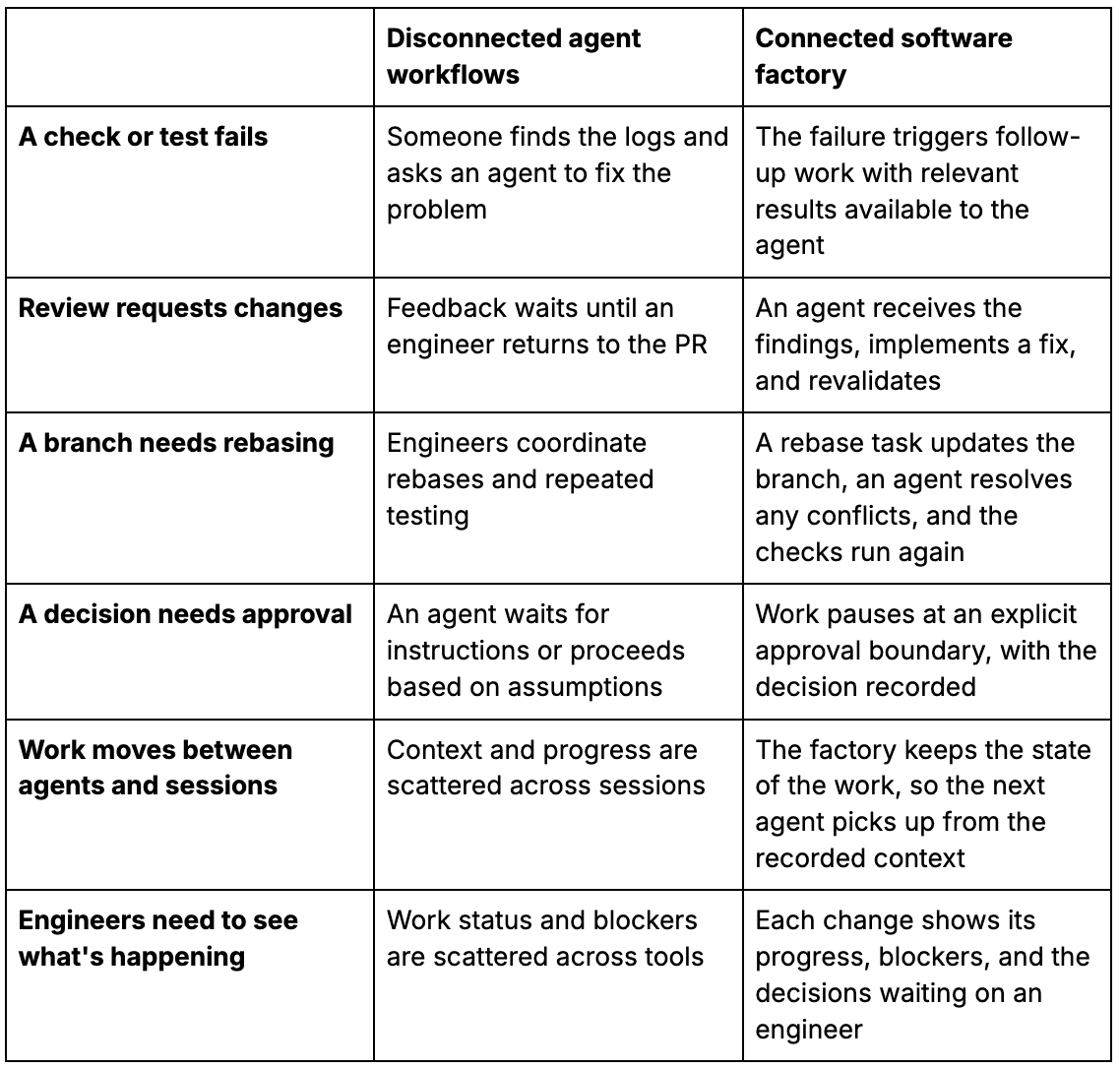
We’ve been investing in making CI more accessible to coding agents, giving them the feedback they need to investigate failures and continue working. But improving individual parts of development doesn’t solve the coordination problem between them. Chunk factory is the system we’re building to connect those capabilities into a reliable process, maintaining context as work moves between agents and giving engineers visibility and control over how changes progress toward merge.
What we’re learning from building our own software factory
We’re beginning to see what a more coordinated development process can deliver. In the repositories where we’re building Chunk factory, weekly merged pull request volume has grown nearly eightfold. In our Chunk CLI repository, median time to merge has fallen from nearly a day to under an hour.
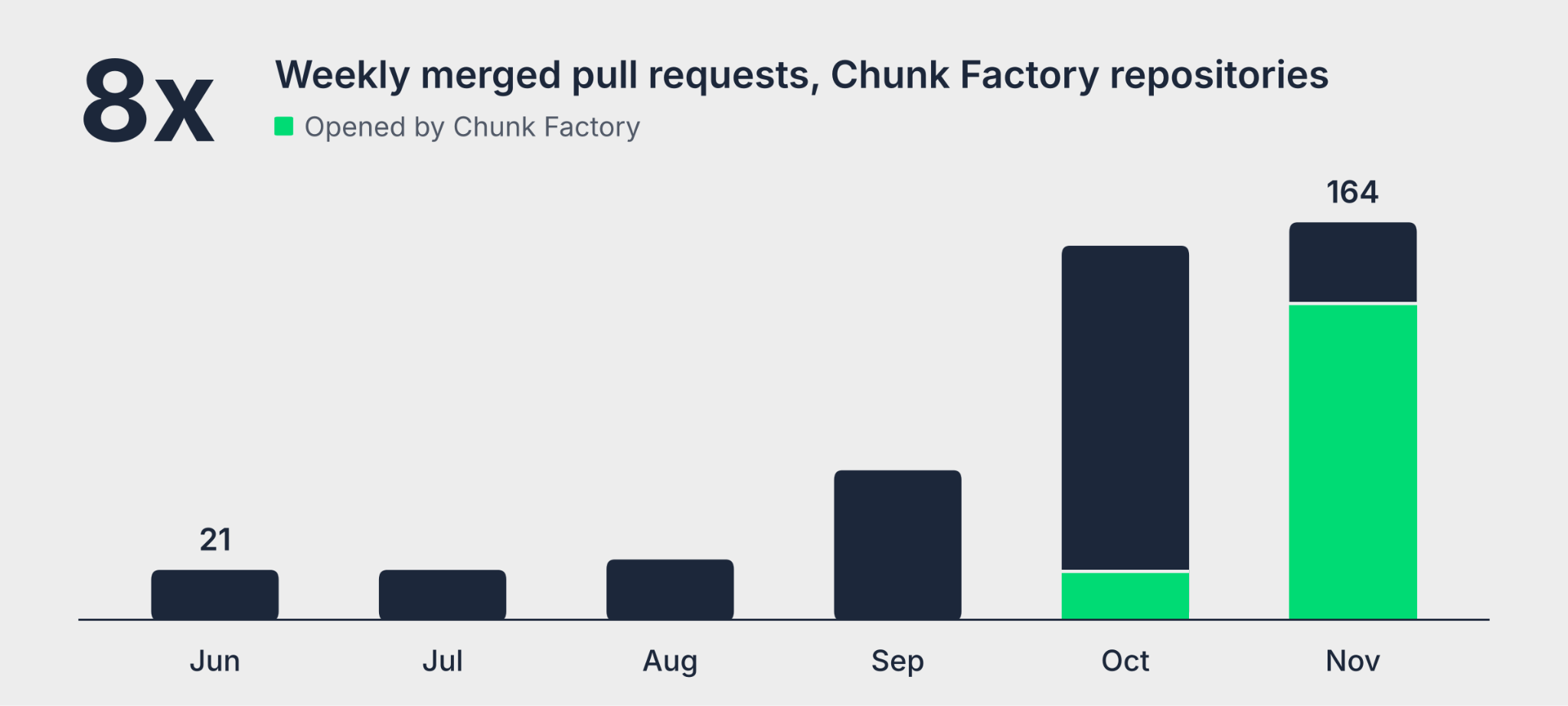
One lesson from building Chunk factory is that removing a bottleneck often reveals the next one. Automating review reduced routine work for engineers, but the process still stalled when an agent needed to address feedback before a change could merge. Connecting review findings directly to agents allowed more of that follow-up work to happen without another manual handoff.
The larger goal is to make parallel agent work genuinely productive. Engineers should be able to kick off substantial tasks and turn their attention elsewhere, trusting agents to stay on track, recover from routine failures, and keep making progress. Our planning workflow gives agents enough direction to work independently while leaving room to adapt as implementation progresses. When a decision requires engineering judgment, the agent asks for guidance rather than guessing.
For that independence to work across agents and sessions, context and decisions need to travel with the work. Chunk factory maintains a persistent record of development tasks and their relationships, so progress doesn’t depend on keeping individual agent sessions alive. Today, it coordinates work from planning through merge preparation, with engineers able to inspect progress and approve consequential decisions. We’re working toward team-wide visibility into plans as well, so engineers can coordinate before agents duplicate effort.
You don’t need to build an entire factory to benefit
Engineering leaders can start by looking at where agent-generated work spends the most time waiting. A few signals can help identify where increased development activity is creating more overhead instead of better delivery:
Review and handoff delays: Where completed agent work sits idle waiting for an engineer to review results or move it to the next step.
Delivery efficiency: How validation cost per merged change and time to get a PR ready for merge change as agent activity increases.
Addressing one bottleneck can deliver meaningful gains without a major infrastructure project. A team might start by reducing redundant test execution or automating routine review, then connect those capabilities so feedback and follow-up work move between them reliably. The goal is to build a delivery process that can support more parallel work without requiring ever more manual coordination.
At CircleCI, we’re applying these lessons to our own engineering work and helping customers navigate many of the same problems. Teams can benefit from the capabilities we’ve developed around CI feedback and agent workflows whether they’re improving individual parts of their process or building toward a more comprehensive factory.
The teams that get the most out of coding agents won’t necessarily be the ones running the most agents. They’ll be the ones with systems capable of turning all that additional development work into software that ships.
See Chunk factory in action
We’re opening up access to Chunk factory as we continue developing it. Join the waitlist if you’d like to try it with your team. We’ll also be at AWS re:Invent with a live demo of what we’re building. Come see us and tell us how your team is managing the surge in agent-generated code.